
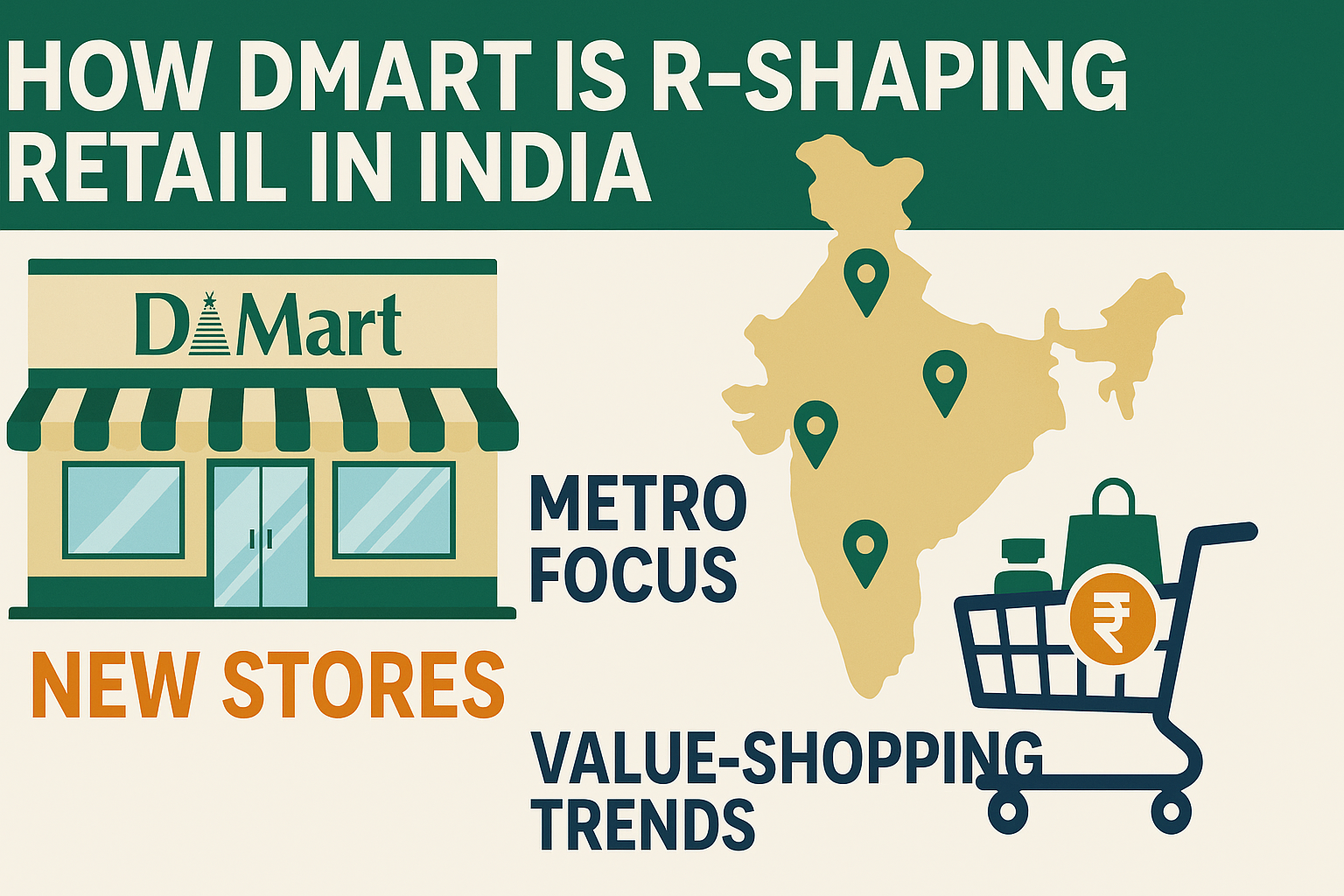
DMart — the retail arm of Avenue Supermarts — is quietly refactoring how millions of Indians shop. Between aggressive store additions, a sharper metro-city focus and an insistence on value-first merchandising, DMart is simultaneously defending its mass-market stronghold and recalibrating for a faster, more competitive retail era. Below I unpack what’s happening, why it matters, and what the numbers and trends suggest for shoppers, competitors and suppliers.
Table of contents (quick links)
- Introduction
- New stores & expansion strategy
- Metro-first play and ecommerce recalibration
- How DMart is delivering value: formats, private labels & price discipline
- Key metrics at a glance (tables)
- What this means for competitors, suppliers & consumers
- Takeaway
Introduction
DMart’s playbook has long been simple: low prices, high inventory turns, and dense store networks that capture weekly and bulk grocery trips. But retail in India has changed — faster online rivals, deeper pockets from Reliance & Amazon, and evolving consumer tastes. In response, DMart is accelerating store additions, leaning into big-city operations for speed and fulfillment, and doubling down on volume-driven value propositions. Angel One+1
New stores & expansion strategy
Over the past 18–24 months DMart’s public statements and filings show a stepped-up expansion push — the company signaled plans to add several dozen stores in the current fiscal cycle (guidance talked of ~50 stores in FY26), with a clear tilt toward northern and metro markets. Adding physical locations remains core to DMart’s economics: each store acts as both a sales engine and a micro-fulfilment hub for nearby e-commerce. The Financial Express+1
Why more stores?
- Faster last-mile reach and lower delivery cost per order.
- Better inventory turns and higher weekly basket sizes.
- Real estate in smaller towns can be profitable, but metros deliver scale, frequency and premium category sales.
Metro-first play and e-commerce recalibration
While DMart expanded aggressively offline, its online arm (DMart Ready) has been through a strategic tightening: scaling fulfillment centres in metros, and pruning operations in smaller cities where unit economics were weak. That shift — pulling back from some non-performing online cities to concentrate resources in metros — signals a strategic pivot: serve dense, urban demand with faster fulfilment and keep lower-profit long-tail markets served primarily by stores. The Financial Express+1
At the same time, DMart’s reported online sales grew (double-digit percent), but losses widened in that segment as the company invested for scale — a reminder that digital grocery is capital-intensive and margin-challenging. The Economic Times
How DMart is delivering value: formats, private labels & price discipline
DMart sells on three levers: price, assortment and convenience. A few notable moves:
- Private labels & owned brands: Industry data shows rising private-label adoption in India — retailers who expand owned brands can protect margins and offer lower price points. DMart has been expanding own-brand SKUs aligned to value shoppers. India Brand Equity Foundation
- Bulk & weekly baskets: Store sizes and layout favor bulk purchases and repeat essentials — keeping average ticket size healthy.
- No-frills store economics: Simple stores, lean inventory systems and centralized procurement drive low operating costs which can be passed on as lower prices.
Key metrics at a glance (tables)
Table 1 — Selected corporate / retail indicators (recent)
| Metric | Recent figure / note | Source |
|---|---|---|
| Planned new stores (FY26 guidance) | ~50 new stores announced | Angel One |
| Q2 revenue growth (YoY) | ~15% growth in recent quarter; revenue ~₹16,218.8 crore (Q2 FY26) | The Economic Times |
| Online sales (FY25) | Online sales jumped ~21% to ₹3,502 crore, but losses widened | The Economic Times |
| Store count (approx.) | 350+ stores (expanding steadily) | Reuters |
Table 2 — Strategic shifts & operational consequences
| Strategic move | Immediate operational effect | Competitive implication |
|---|---|---|
| More stores, metro focus | Higher fulfilment density; faster delivery in metros | Stronger local dominance vs instant-delivery players |
| Exit smaller online markets | Reduced opex; focus on profitable corridors | Competitors may fill gaps with hyperlocal models |
| Private label growth | Improved margins; price leadership | Pressure on national brands; better margin control |
Intra-article links (jump to sections)
- Jump to New stores & expansion strategy.
- Jump to Metro-first play and e-commerce recalibration.
- Jump to How DMart is delivering value.
(These are internal anchors — use them to navigate quickly.)
What this means for competitors, suppliers & consumers
Competitors: Reliance, Big Bazaar/Trent, Amazon and local chains will compete on assortment, loyalty and speed. DMart’s physical density gives it an edge in bulk grocery and weekly essentials, while rivals with better digital ecosystems can win convenience and premium categories.
Suppliers: DMart’s procurement scale and private-label push mean bargaining power increases for large suppliers — but niche premium brands may find distribution harder without differentiated positioning.
Consumers: Value-seeking shoppers gain: lower everyday prices, broader private-label choices, and faster delivery in metro pockets. Urban consumers will see better omnichannel experiences; rural or smaller-town shoppers may continue to rely on stores where DMart’s economics remain strong.
Data & trends that reinforce the picture
- Sector analyses indicate India’s retail market is still growing rapidly, and private labels are capturing share — a trend DMart is positioned to exploit. India Brand Equity Foundation+1
- Quarterly results show DMart’s revenue growth continues in double digits even as the company navigates higher e-commerce investments. The Economic Times+1
Takeaway
DMart’s current strategy — aggressive store rollouts combined with a pragmatic, metro-focused e-commerce approach — is a pragmatic mix of old and new retail playbooks. The company is doubling down where its unit economics work best (dense metro catchments and big-ticket weekly shopping) while experimenting with digital scale where it makes sense. For shoppers, that typically means better value and wider private-label options; for competitors, it raises the bar on cost discipline and fulfillment density.
Sources (selected)
- Avenue Supermarts / DMart expansion & guidance reporting. Angel One+1
- Quarterly results & revenue figures. The Economic Times+1
- DMart online sales, FY25 growth and online losses. The Economic Times
- Coverage of metro focus and consolidation in online operations. The Financial Express+1
- Industry retail trends and private label notes. India Brand Equity Foundation+1
Are you planning to go grocery shopping and write on paper? why don’t you try Trupricer.com a digital shopping list creator Using trupricer mobile app, you can create a digital monthly shopping list in the app and there is no need to struggle with writing a list on paper every time
Andriod store link to download the app: https://play.google.com/store/apps/details?id=com.trupricer.user
IOS app store link :https://apps.apple.com/in/app/tru-pricer/id6480042106
